

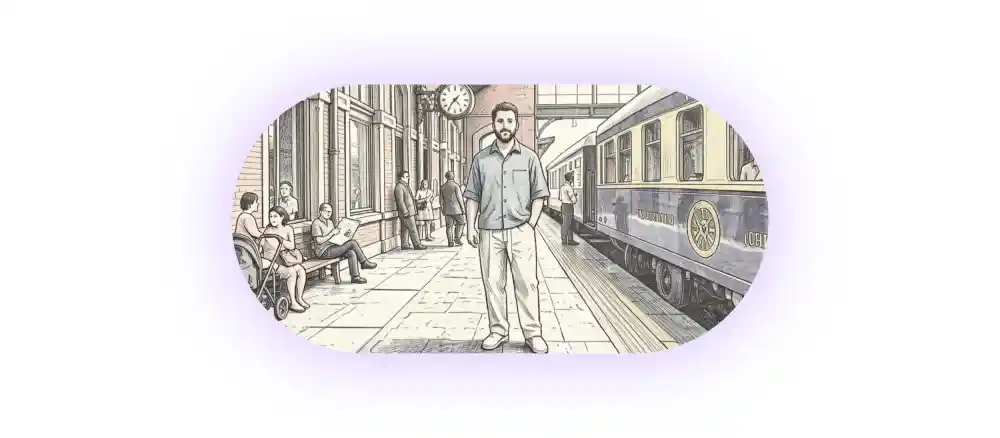
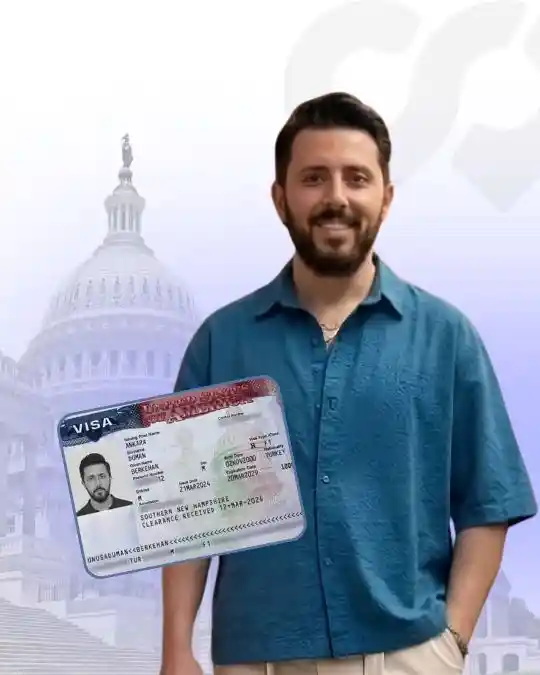
Berkehan built his own DS-160 and financial file with Utter Vision's videos, then used a lawyer consultation to prep for one hard interview question. When his cybersecurity field triggered a routine security review, he already knew it wasn't a red flag — just a wait.
He Had to Pass a Security Check to Go Study Security
Berkehan Duman's US student visa was issued March 21, 2024, nine days after a security clearance came through that had nothing to do with anything he'd done wrong, and months after an application he'd put together entirely himself.
Berkehan is 23, from Izmir, Turkey, born November 2, 2000. After a two-year vocational program in IT, he spent a couple of years working as a help desk technician at a mid-sized company, mostly resetting passwords and untangling printer problems, work he was good at and thoroughly unexcited by.
That changed the week a phishing email got three people in his office to hand over their logins, and he ended up being the one who noticed the pattern in the login attempts before the company's actual IT security contractor did.
It was the specific moment cybersecurity stopped being an abstract interest he read about at night and became the thing he actually wanted to study properly.
He applied to Southern New Hampshire University's on-campus cybersecurity program, drawn partly by its flexibility around start dates, and was accepted for a spring term.
His father, Hakan, an electrical technician himself, mostly wanted to know if the degree would actually get him a better job than the one he already had, a fair question Berkehan didn't have a fully satisfying answer to yet.
Getting accepted turned out to be the easier half.
Berkehan had never filled out anything like a US visa application before, and the DS-160 form alone, the first time he opened it, looked long enough that he closed the tab and left it for two days.
He found Utter Vision while searching for a plain explanation of what the form was actually asking, and used its instructional videos to work through it section by section instead of guessing.
The videos walked through exactly what financial evidence a visa officer wants to see for a self-funded student — his own savings built up from two years of work — and how to organize his I-20 and acceptance letter so nothing about his SEVIS record looked incomplete or inconsistent going in.
The interview preparation mattered just as much.
Berkehan booked a short consultation with one of Utter Vision's lawyers mainly to practice explaining, out loud, why someone with two years already in IT support wanted to go back to being a student — a question he suspected an officer would ask and didn't yet have a clean answer for.
The lawyer's advice was simple: connect the phishing incident directly to the decision, in one or two sentences, rather than a longer explanation that tried to justify the whole career change.
It was still Berkehan's own file and his own words at the interview. The preparation just meant he wasn't improvising an answer to the one question he'd been quietly dreading.
The interview itself, at the consulate in Istanbul, went by in a few unremarkable minutes.
What the officer told him afterward wasn't a refusal.
It was that his case would need additional administrative processing before a final decision, because of his declared field of study.
Certain technical fields, cybersecurity among them, routinely trigger an extra layer of security review in the US visa system, regardless of anything specific to the applicant sitting across the desk.
It isn't personal, and it isn't optional, and there's no fixed timeline attached to it.
Berkehan had never heard of this before that afternoon, and spent the drive home searching forums full of other applicants' wildly different wait times, none of it especially reassuring.
What helped most in the weeks that followed wasn't anything that could speed up a security review nobody outside a few government offices actually controls.
It was simply understanding what the wait meant and didn't mean — not a red flag on his record, not a rejection in slow motion, just a category of review a lot of technical fields fall into automatically.
He kept his financial documents current rather than letting them go stale over months of waiting, and kept his I-20 and acceptance paperwork in one folder, ready if anyone asked for anything again.
None of that touched the review itself. It just meant that once it cleared, there was nothing else left to hold the visa up behind it.
The clearance came through on March 12, 2024, a little over two months after his interview.
The visa was issued nine days later, on March 21, once the paperwork caught up with a decision that had, in practice, already been made.
Berkehan flew to New Hampshire that spring, in time for the program's next intake, and moved into a shared apartment near campus with two other international students, one of them also Turkish.
He's a few semesters into the program now, and picked up a part-time role at the university's own IT help desk, which he describes as the same job he had in Izmir with better equipment and noticeably worse coffee.
Hakan still asks about the job prospects every few calls.
Berkehan has started sending him actual articles about cybersecurity salaries instead of re-explaining the degree from scratch each time.
Berkehan says the application and the wait taught him two separate lessons that happened to arrive in the same envelope.
Filling out the file himself meant he actually understood what he'd submitted and why.
Waiting on the clearance afterward meant learning that not every delay is a verdict — some of them are just a category a person's chosen field happens to fall into, with nothing left to do but keep the rest of the file ready in the meantime.
 WhatsApp
 Twitter
 FaceBook
 Linkedin