

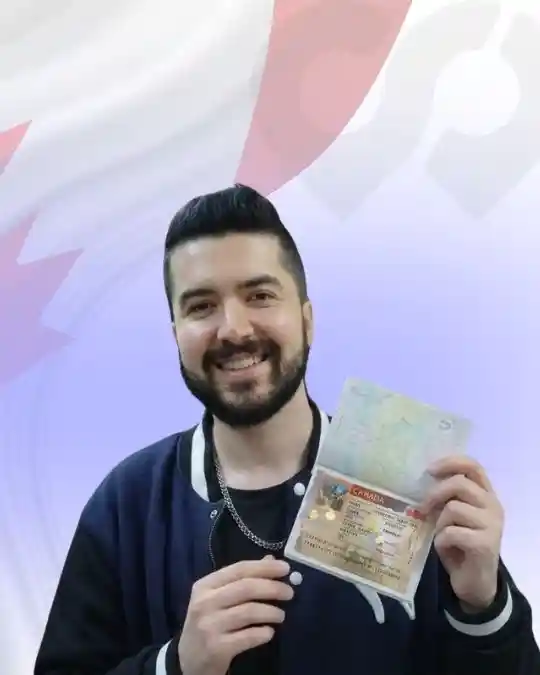
Mehmet's own university had no idea how to send a transcript directly to a foreign credential assessment service — two attempts came back wrong. Utter Vision gave him the exact reference number and channel to hand his registrar, and the third attempt finally worked.
His Own University Had Never Been Asked to Send a Transcript Like This Before.
Mehmet Yilmaz's Canadian permanent residence, through the Federal Skilled Worker Program, was issued February 27, 2024, on paperwork that took less effort to write than it took to get his own university to actually send.
Mehmet is single, from Istanbul, Turkey, with a master's degree in civil engineering from Istanbul Technical University and eight years of experience since, mostly on infrastructure and bridge projects for a mid-sized engineering firm. He'd been looking into a Canadian study visa when he mentioned it to his cousin Burak, already in Canada finishing his own degree, who told him plainly that with eight years of real engineering experience and an advanced degree already behind him, applying as a student made far less sense than applying through Express Entry as a skilled worker. Burak was the one who first mentioned Utter Vision.
Mehmet worked through the process the way it's actually built: confirming his occupation and age qualified, studying for the English exam and scoring comfortably above the required benchmark, and then facing the step that actually decides most of a skilled worker's score — the educational credential assessment, the process that converts a foreign degree into a recognized Canadian equivalency for points purposes. For a foreign degree to count, the assessing body needs official transcripts sent directly from the university itself, not forwarded by the applicant, and Istanbul Technical University's registrar's office had never fielded a request quite like this before.
His first request got him a sealed transcript mailed to his own home address instead of to the assessment organization, technically responsive to what he'd asked for but useless for the actual purpose. A second attempt, a little more specific, produced a similar result. The problem wasn't that his university doubted his degree. It was that "send this directly to a foreign credential assessment service, using their reference number, through their required channel" simply wasn't a request the registrar's office had a standard process for, and each attempt to explain it more clearly seemed to generate a slightly different, still incorrect response.
Utter Vision was where he finally found the specific mechanics of what to actually tell the registrar: the exact reference number the assessment organization assigns each applicant, the precise electronic or sealed-mail channel they require, and a short, plain letter he could hand to the registrar directly rather than trying to explain the process over email through several layers of staff. The fix wasn't complicated once it was specific enough. It just needed to stop being a vague request and start being an exact one, addressed to the right person with the right reference attached.
The third attempt worked. His credential assessment came back a few weeks later, confirming his degree's Canadian equivalency in full. With that in hand, he calculated his score under the comprehensive ranking system, created his Express Entry profile, and received an invitation to apply in the next draw.
From there, the sixty-day window began, and Utter Vision's role shifted to the application itself — police certificates, a medical exam, and the full supporting document set, reviewed by lawyers on the platform before submission, who caught an inconsistency between how two different documents spelled his middle name that would otherwise have needed separate correspondence to fix later.
His permanent residence was confirmed February 27, 2024. Mehmet moved to Calgary that spring, and has spent the months since both settling into a new engineering role and starting the separate, entirely unrelated process of provincial licensing to practice formally as a professional engineer, a credential Express Entry never required but his actual career eventually will.
Burak still teases him about the transcript saga more than anything else from the whole process, mostly because he went through the exact same thing with a different university two years earlier and never once thought to warn Mehmet in advance.
Mehmet says the visa itself was never really the hard part. The hard part was discovering that his own alma mater, the place that had actually taught him everything on the degree in question, had no idea how to prove it to anyone else — and that fixing that took nothing more than finding the one specific, correct way to ask.
 WhatsApp
 Twitter
 FaceBook
 Linkedin